
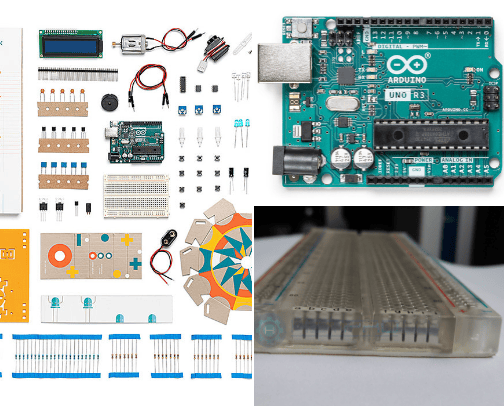
The Arduino is an open-source hardware platform based on a board with a microcontroller and a development environment. It’s designed to make electronics accessible for multidisciplinary projects. With Arduino, you can bring your ideas to life, from simple prototypes to complex automated systems.
Features:
Atmega328 Microcontroller: The heart of Arduino, allowing flexible and versatile programming.
Digital Inputs and Outputs:
Digital Inputs: Connect sensors, buttons, or switches to read data.
Digital Outputs: Control LEDs, relays, or other devices.
Analog Inputs: Measure continuous signals (e.g., temperature, light intensity).
Analog Outputs: Generate variable voltage levels (e.g., control motor speed).
PWM (Pulse Width Modulation): Create analog-like signals using digital pins.
Serial Communication: Interact with other devices (e.g., sensors, displays) via UART, SPI, or I2C.
Expandability: Add shields or modules for additional functionality (e.g., Wi-Fi, Bluetooth, GPS).